

During the Meta Connect 2022 keynote on the 11th of October 2022, Mark Zuckerberg finally unveiled the long-awaited Meta Quest Pro Virtual Reality headset. This will be the first of a series of advanced VR headsets focused on creativity and collaboration between developers. Formerly referring to the device only as “Project Cambria”, Meta took great care to only partially reveal certain information regarding what we now know as the Meta Quest Pro.
After a long time of only being shown occasional glimpses of the headset and its features, we finally have access to all the details, specifications and information surrounding the groundbreaking new development in Virtual Reality technology.
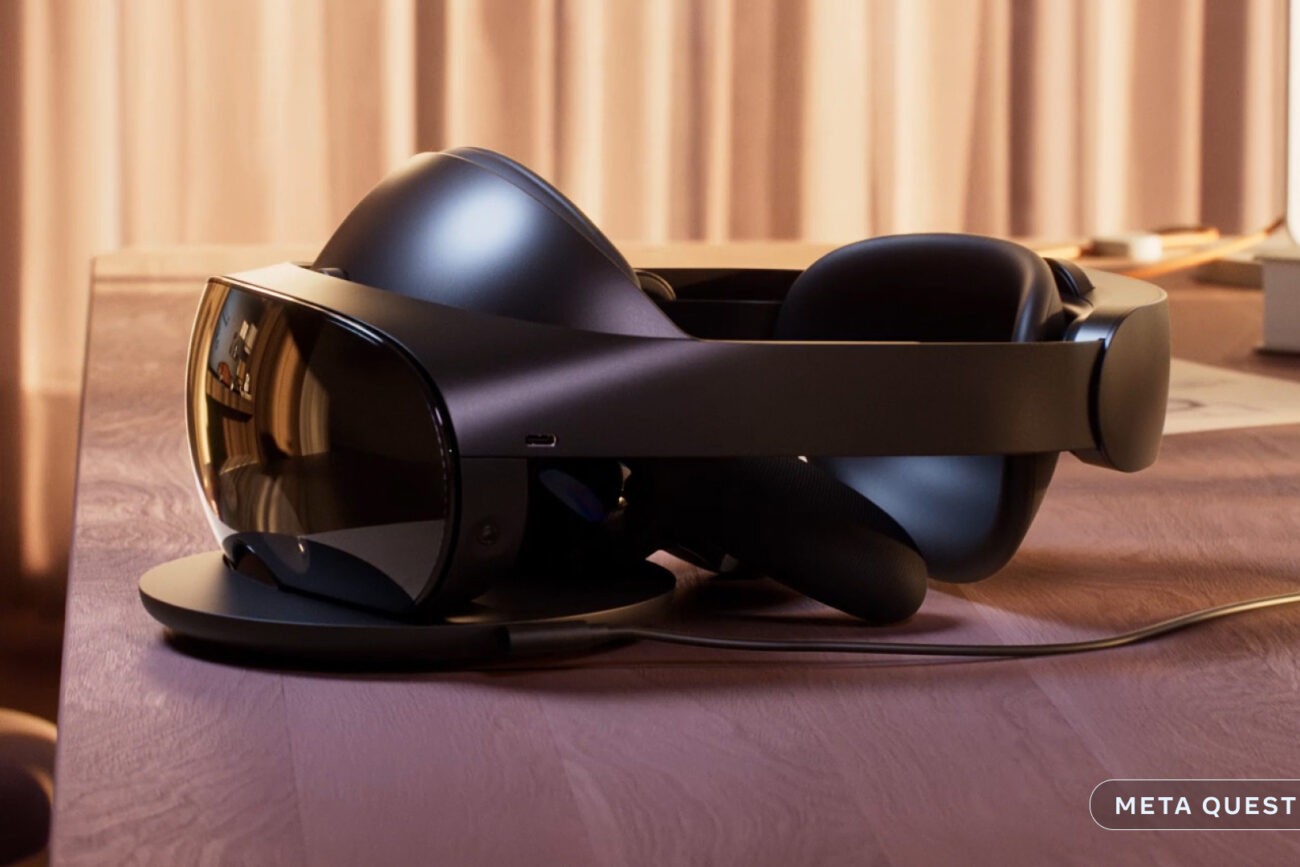
The Meta Quest Pro boasts a newer, lighter and more streamline design. Due to the curved battery being placed at the back of the headset, the device feels significantly more balanced than any of its predecessors.
The controllers also sport a refreshed design, being the first Quest controllers to not have tracking rings. They instead contain three built-in tracking sensors, allowing the controller to track its own position without assistance from the headset itself. Additionally, the controllers will feature rechargeable batteries. These controllers are even compatible with the Meta Quest 2 and can be purchased as standalone products.
The Quest Pro will also be compatible with a wide range of all-new accessories, including a full light blocker, VR earphones and a two-in-one compact charging dock for the headset and controllers.

The Meta Quest Pro comes with an astounding amount of features, both brand new, and improved from previous headsets.
The Quest Pro features groundbreaking optics known as pancake lenses that repeatedly fold light several times over before casting that light to the user’s eyes. The shape and density of these lenses allow the headset to be far more compact than ever while simultaneously having much better graphics.

Making use of state-of-the-art inward and outward facing sensors, the Quest Pro is capable of tracking the user’s eye and facial movement. This will allow for vastly more expressive and natural-looking avatars in the Metaverse. This means that users with the Quest Pro will automatically have a more natural and real presence during meetings and gatherings.
The Quest Pro’s controllers feature a new, ergonomic design that enhances the idea that the controllers are an extension of the user’s hands. Additionally, they also come equipped with a stylus tip, allowing them to act as pens whenever the user needs to make any important notes.
Specifications
The Quest Pro is equipped with the Qualcomm Snapdragon XR2+ chipset, boasting unparalleled performance and power. This allows support for 8K 360° video, true mixed reality and context-aware voice UI. Full-colour high fidelity passthrough is also a key feature of the Quest Pro, allowing Mixed and Augmented reality to be more immersive than ever before. The pancake optic lenses, while significantly more compact, allow for an astounding resolution of 1800×1920 per-eye and visible field of view of 106° horizontally and 96° diagonally. Behind the lenses are two upgraded LED screens with significantly improved sharpness and colour, boasting a 25% increase in overall sharpness from the Quest 2. However, it is equipped with a maximum refresh rate of only 90Hz, with a 72Hz mode also available.

In addition to the powerful processing unit and high quality visuals, the Quest Pro also features a storage space of 256GB, as well as 12GB RAM, doubling that of the Quest 2.
Unfortunately, due to the high amount of high-end hardware and software it comes equipped with, the Quest Pro has a short battery life of only 2 hours.
Pricing
Due to the several advanced high-end features the Meta Quest Pro is equipped with, it will be significantly more expensive than The Quest 2. Being available to purchase for around $1499, which excludes the wide range of accompanying accessories, this new headset will not be focussed at the average user and is instead meant to be aimed at developers and creators. However, the Quest Pro’s controllers can be purchased on their own for $299.

It would seem that while the Quest pro is a remarkable improvement from any of the headsets that came before it, it is clearly not meant for the majority of Meta’s target audience due to its price being significantly higher. However, Meta has stated that the Quest Pro will be a developer-focused device, and that the Quest line will continue with the Quest 3 once again being focused towards the average user. It remains to be seen how much of the Quest Pro’s features will eventually be carried over to the Quest 3. However, more concrete information surrounding the Quest 3, as well as its release date, is yet to be announced.